
News
Finding a voice in Speech-Language Pathology
By Marcelle da Costa Santos
In 2020, during the COVID-19 pandemic, Demi Bernard (’27) was working behind the pharmacy counter at a Walgreens when a customer came in to buy something that required identification. When she asked him for it, he looked at her, confused. After a few moments, she realized he was deaf and couldn’t read her lips through her mask.
Drawing on the American Sign Language (ASL) she had learned in high school, she signed “ID” to him. Suddenly, everything clicked. “The way that man’s face lit up, finally feeling like he was being understood — that someone had taken the initiative to understand him and step into his world — was very inspiring to me,” she said.
Days later, she changed her intended major from nursing to speech-language pathology at North Carolina A&T State University in Greensboro, a decision that eventually led her to pursue a Master of Science in Speech-Language Pathology at Northeastern University in Charlotte.
Standing out in the field
Now in her third semester, Bernard is excelling. She received the 2026 Outstanding Global Network Student Award for the Charlotte campus. The award is given annually to one student per campus across Northeastern’s global network in recognition of academic achievement and accomplishments outside the classroom.
Her path into speech-language pathology (SLP) was not typical. She had never had speech therapy herself, nor did she know anyone who had. But the ASL classes she took in high school gave her a new perspective on communication. They taught her, she said, “what it means to live in a world that is not set up for you to communicate, and not set up to communicate back to you.”
Over time, she grew to love SLP for the range of opportunities it offers and the close-knit and dedicated network of professionals in the field. She experienced that sense of community firsthand after presenting what she described as rudimentary research at a symposium. There, a scholar approached her and praised her work. “I remember thinking that he probably knew more about what I was talking about than I ever would in my entire life, but he was so enthusiastic about me learning about it and presenting on it,” she said.
That was a turning point for her. “I thought, ‘I want to be like him one day — someone who keeps people in this profession just by being enthusiastic about what I’m passionate about.’”

Finding the right fit: for school, and for a career
At the time, she was an undergraduate at North Carolina A&T, a historically Black university, where she was part of a small cohort that “felt like family.” “A&T felt like a safe space to develop not just as a college student, but as a young woman,” she said.
When it came time to choose a graduate program, she looked for the same sense of belonging she had found at A&T. Northeastern wasn’t initially on her radar, and after learning about the program at a career fair, she visited the campus. During the tour, program director Nia Johnson and instructor Christine Cook showed an interest in her as a person, she said.
“I thought, this is where I won’t feel like a number; I’ll feel like an individual and be treated as one.” Of the eight schools she considered, Northeastern in Charlotte became her top choice. She said she liked the idea of being “a small slice of a much larger community.”
Experiential learning through clinical placements
At Northeastern, she found a closely connected environment while broadening her experience through clinical placements. Her first placement was at the Speech-Language Center, the campus’ pro bono clinic. She worked directly with children from the community, helping them develop their speech and articulation skills. Her work there contributed to her nomination for the Outstanding Global Network Student Award.
For her next placement, she worked in public schools, screening and treating children and adolescents. Now she is in private practice, splitting her time between a day care, a private clinic, and an ABA center.
She points to the range of the work as one of its rewards. “We interact with such a diverse population, and it opens you up to amazing stories,” she said. But what matters most to her is the opportunity to empower people to communicate. “Everybody deserves to understand and be understood.”
Northeastern University’s MS-SLP program is accredited by The Council on Academic Accreditation in Audiology and Speech-Language Pathology of the American Speech-Language-Hearing Association. If you’re interested in enrolling, or learning more about the program click here.
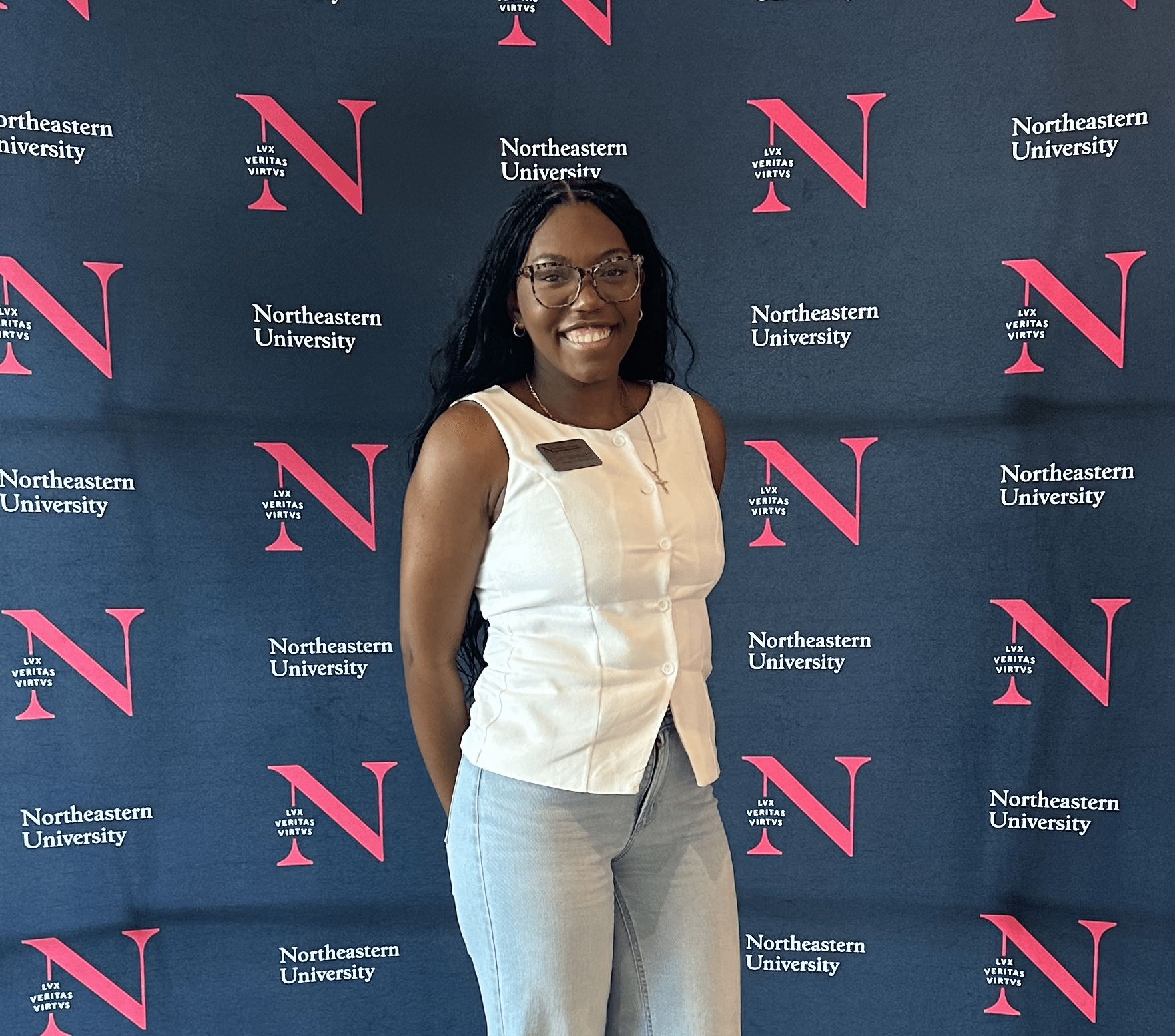
“I thought, this is where I won’t feel like a number; I’ll feel like an individual and be treated as one.”
Demi Bernard, Master of Science in Speech-Language Pathology Candidate, Class of 2027